Monday, March 4, 2013

who baptised john the baptist

an 24, '13, 2:16 pm
Regular Member
 
Join Date: January 18, 2010
Posts: 3,188
Religion: catholic
Default Re: Who Baptized John the Baptist?

Quote:
Originally Posted by Evan View Post
Please note that the requirement for Baptism did not come about until after the Resurrection. So, as Hebrew people, obeying the commandments of God, John and Mary both fell under the old covenant with Moses and the Children of Abraham.

Moses and Elijah were never baptized, yet the Church regards them as Saints.
Yes, they had OT circumcision, for the males ....what was requirement for women ?

Now, Trinitarian water baptism became the Norm on that first Pentecost / birth of NT Church.
Reply With Quote Multi-Quote This Message
  #32   Report this Post to the Moderator  
Old Jan 24, '13, 2:32 pm
Regular Member
 
Join Date: January 18, 2010
Posts: 3,188
Religion: catholic
Default Re: Who Baptized John the Baptist?

Which means Mary & John's receipt of HS and their Fully Graced status is beyond/outside our NT norms. John never knew the Church, but Mary did.

So, PJM ...

WE ARE BOTH WRONG !
Reply With Quote Multi-Quote This Message
  #33   Report this Post to the Moderator  
Old Jan 24, '13, 3:15 pm
Regular Member
 
Join Date: May 19, 2004
Location: Seattle
Posts: 1,869
Religion: Catholic
Default Re: Who Baptized John the Baptist?

Quote:
Originally Posted by brb3 View Post
Yes, they had OT circumcision, for the males ....what was requirement for women ?

Now, Trinitarian water baptism became the Norm on that first Pentecost / birth of NT Church.
That was one of the advantages of the new Israel. Women and men were equally qualified to sacramentally enter into the Church covenant.

In OT religion women were associated with a husband or parents. There was no covenantal sign.
__________________
===========
Evan
Reply With Quote Multi-Quote This Message
  #34   Report this Post to the Moderator  
Old Jan 24, '13, 3:32 pm
patrick457's Avatar
Veteran Member
 
Join Date: September 7, 2006
Location: 東日本
Posts: 10,933
Religion: Catholic: sinner in need of salvation
Default Re: Who Baptized John the Baptist?

Quote:
Originally Posted by TimothyH View Post
BRB has it right.

John was given the equivalent of baptism in his mother's womb, when the voice of Mary came to Elizabeth's ears and John lept for joy. This was John's justification and sanctification, which was acomplished by the power of Jesus through the voice of Mary, prior to John's birth.

Patrick is also correct. The ritual immersion which was taking place was a purification bath called a Mikveh. Jews still practice it. One confesses sin and is ritually purified by immersion in "Living" AKA running water.


-Tim-
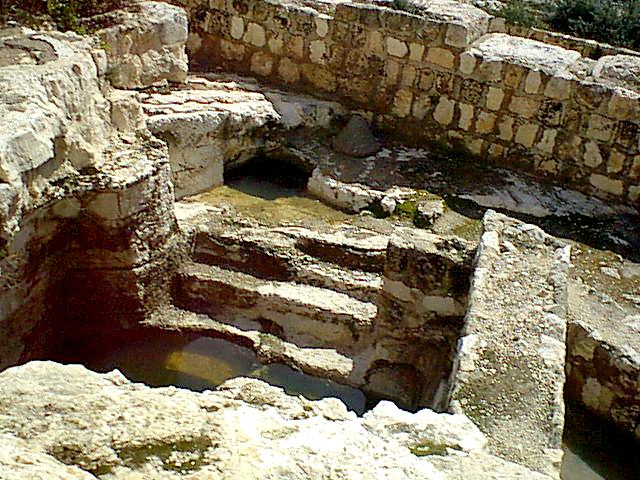
Yes. Miqveh ("a collection") BTW refers to the pool; the practice of full-body immersion itself is called tevilah. Generally speaking you immerse yourself in said pool whenever you become ritually unclean due to some reason or other (menstruation and other discharge of bodily fluids, childbirth, skin diseases, contact with a corpse or a grave, etc.). Immersion could also be performed during certain occasions (like the eve of Sabbath and Yom Kippur) as a means to purify oneself.

The general requirement for a miqveh is that they must have enough water to cover a single person, and that the water must be 'living' water (water freely running from a source: water from natural springs or wells, rainwater, snow, ice, and hail are all valid) as opposed to 'drawn' water.

Miqvaoth, as mentioned, could be found everywhere: some might have a communal miqveh, others (especially the wealthy or the priests) might have one in their house. Considering that no unclean person could enter the Temple area, there are also a lot of such pools in Jerusalem, especially in the vicinity of the Temple Mount.


Miqveh (Magdala)


Miqveh (Qumran)
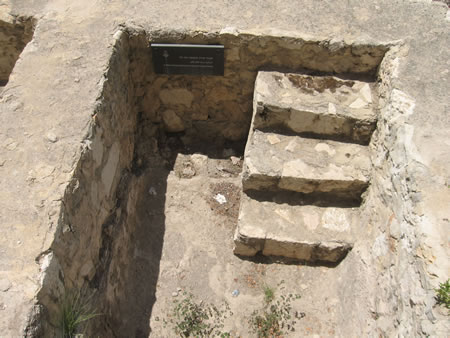


Miqvaot near the Temple (Jerusalem)


Miqveh (Bat Ayin)


Miqveh Cave (Ein-Gedi)


Miqveh (Herodium)
__________________
Please pray for me. That's the least you could do.

"What is man,
that you make so much of him,
and that you set your heart on him,
visit him every morning
and test him every moment?"


Reply With Quote Multi-Quote This Message
  #35   Report this Post to the Moderator  
Old Jan 27, '13, 2:56 pm
PJM PJM is offline
Senior Member
 
Join Date: August 31, 2008
Location: Centeral Florida
Posts: 8,522
Religion: Informed, practicing RomanCatholic
Default Re: Who Baptized John the Baptist?

Quote:
=brb3;10279802]Yes, they had OT circumcision, for the males ....what was requirement for women ?

Now, Trinitarian water baptism became the Norm on that first Pentecost / birth of NT Church.
Women were ASSUMED and Included through the husband or father to be included in the OT Covenant.
__________________
PJM


http://working4christ2.wordpress.com

Can we partake of God's GLORY and NOT partake of His PASSION? NO!


A.B. Fulton Sheen: "The truth is the truth even if nobody believes it, and a lie is still a lie, even if everybody believes it."
Reply With Quote Multi-Quote This Message
  #36   Report this Post to the Moderator  
Old Feb 10, '13, 8:24 pm
Trial Membership
 
Join Date: February 10, 2013
Posts: 1
Default Re: Who Baptized John the Baptist?

In Acts, it says the apostles baptized in the name of Jesus; is it sufficient just to baptize in the name of Jesus or does it need the Trinitarian blessing? I was having this discussion with a protestant and it left me thinking if the disciples actually followed Jesus' commandment to baptize in the name of the Father, Son and Holy Spirit.
Reply With Quote Multi-Quote This Message
  #37   Report this Post to the Moderator  
Old Feb 10, '13, 9:08 pm
New Member
 
Join Date: April 9, 2012
Location: Washington
Posts: 91
Religion: Catholic
Default Re: Who Baptized John the Baptist?

Quote:
Originally Posted by oneofmany View Post
Did John the Baptist get baptized? Who did it or did he baptize himself? When Jesus came to be baptized, why didn't John ask Jesus to baptize him?
This is "way out there", but perhaps he was to be born at the time of Christ, he was already baptized before being born "in some way". Then he started baptizing later on. Or, he baptized himself in the waters while praying. But overall, I don't think scripture mentions.
Reply With Quote Multi-Quote This Message
  #38   Report this Post to the Moderator  
Old Feb 11, '13, 1:10 pm
Banned
 
Join Date: February 11, 2013
Posts: 3
Religion: catholic
Default Re: Who Baptized John the Baptist?

thanks -- for this thread

it is interesting to see how the development of false beliefs are developed,

i have studied under a few Hebrew roots scholars--some of the answers show why Saint Paul warned about believing myths and traditions of men..

kind a like Valentine day, as some one how it came about and you get many different beliefs. duh?? maybe if it sounds good. it must be true..

it's been the tradition for years to believe --"fill-in-da-blank" so it must be true.

Hermeneutics (/hɜrməˈnjuːtɪks/), broadly, is the art and science of text interpretation.
Exegesis involves an extensive and critical interpretation of a text, especially of a holy scripture, such as of the Old and New Testaments of the Bible, the Talmud, the Midrash, the Qur'an, etc. An exegete is a practitioner of this science, and the adjectival form is exegetic.

The word exegesis means "to draw the meaning out of" a given text. Exegesis may be contrasted with eisegesis, which means to read one's own interpretation into a given text. In general, exegesis presumes an attempt to view the text objectively, while eisegesis implies more subjectivity.

One may encounter the terms exegesis and hermeneutics used interchangeably; however, there remains a distinction.
Reply With Quote Multi-Quote This Message
  #39   Report this Post to the Moderator  
Old Feb 11, '13, 3:47 pm
PJM PJM is offline
Senior Member
 
Join Date: August 31, 2008
Location: Centeral Florida
Posts: 8,522
Religion: Informed, practicing RomanCatholic
Default Re: Who Baptized John the Baptist?

Quote:
=Rozell1;10342275]In Acts, it says the apostles baptized in the name of Jesus; is it sufficient just to baptize in the name of Jesus or does it need the Trinitarian blessing? I was having this discussion with a protestant and it left me thinking if the disciples actually followed Jesus' commandment to baptize in the name of the Father, Son and Holy Spirit.
Matthew 28:19-20

AND JESUS SAY'S " [19] Going therefore, teach ye all nations; baptizing them in the name of the Father, and of the Son, and of the Holy Ghost. [20] Teaching them to observe all things whatsoever I have commanded you: and behold I am with you all days, even to the consummation of the world"
__________________
PJM


http://working4christ2.wordpress.com

Can we partake of God's GLORY and NOT partake of His PASSION? NO!


A.B. Fulton Sheen: "The truth is the truth even if nobody believes it, and a lie is still a lie, even if everybody believes it."
Reply With Quote Multi-Quote This Message
  #40   Report this Post to the Moderator  
Old Feb 18, '13, 9:05 am
Banned
 
Join Date: February 9, 2013
Posts: 8
Religion: protestant
Default Re: Who Baptized John the Baptist?

Quote:
Originally Posted by Rozell1 View Post
In Acts, it says the apostles baptized in the name of Jesus; is it sufficient just to baptize in the name of Jesus or does it need the Trinitarian blessing? I was having this discussion with a protestant and it left me thinking if the disciples actually followed Jesus' commandment to baptize in the name of the Father, Son and Holy Spirit.

well my experience is that " if it does not lead to Jesus baptising you with the Holy Spirit" then all you did was get "wet"

1sam10, acts19,acts 10 is an example of what happens .. most protestants and roman catholics weem to "just get wet"
Reply With Quote Multi-Quote This Message
  #41   Report this Post to the Moderator  
Unread Today, 8:28 am
Trial Membership
 
Join Date: February 27, 2013
Posts: 2
Religion: charasmatic
Default Re: Who Baptized John the Baptist?

Quote:
Originally Posted by DaveBj View Post
See patrick457's post #10. The mikvah could have been considered a sort of baptism. And the word "baptism" doesn't necessarily mean "Christian baptism;" for starters, John's baptism was not a Christian baptism.

I don't know. It just appeared in the Gospels, with John preaching repentance and then dipping repentant sinners in the waters of the Jordan River.
thanks -- for this string -- to demenstrate the difficulity of recognizing that the mikvah- in the Hebrew tradition was was being performed by John - as also referenced in hebrews 6- where it references moveing on to the foundations o "baptisms"
it is necessary to to read about the "hebrew roots" of this God made ceremony,

to avoid developing imaginary and man made understanding of what the scripture means.

as peter said "be mikvah in the water of repentence and receive the gift of the Holy Spirit,

this is why paul said in acts 19 what were you "baptised" or mikvah in?

so he got them mikvah in the Holy Spirit-- and there is a difference-- between the two baptism's or mikvah- other wise -- why bother

so -- obviously-- john the baptis -- what Mikvah in water as was the tridition in the religious ceremony-- i suggest that the readers of this string-- research and learn what the baptism or mikvah is all about--

so you don't become mis-lead or deceived

Sunday, March 3, 2013

One Night in Bangkok -In AD 306, Constantine became the first Christian Roman Emperor.

ok
Why don't we as Christians and followers of Jesus and "the Christ" keep and observe the Biblical Holy Days in the Christian Church today?


We can begin to look at Constantine to find the loss of the Biblical Holy Days and the Sabbath for the non-Jew.


Let us learn an important truth from 2 Thess. 2:3


"Let no man deceive you by any means, for that day will not come unless the falling away comes first, and the man of sin is revealed, the son of perdition who apposes and exalts himself above all that is called God or that is worshiped so that he sits as God in the temple of God."
Let us look no further than Constantine to be one of many who fulfills this passage. 


As far as the history of christianity is concerned, Constantine was one of the most influential men that ever lived. 


From the Writings of the Apostles (Gospel’s), until Martin Luther nailed his theses to the church door in 1517, there was no single person that so changed the course of church history as Constantine did. 


Indeed, his influence was so vast that it continues to tower over Christendom in this, our own time. 


Both in church customs, doctrines and in church government, christianity owes sunday and a lot more to Constantine’s intervention.


It may be news to you but Constantine began to change the Biblical Holy Days, forsaking the Shabbot and assigning Sunday as God's day. 

He outlawed the 7 Biblical Festivals and Feasts of God as well.

 He replaced them with pagan holidays derived from Sun Worship which find their origins with men.

 If we look at the Shabbot this should not be surprising to us for after all, the Gentiles (pagans) were already used to Sunday worship due to their background in "Sunday" - "Sun" worship. 


The logic of Constantine was very simple: "As more and more Gentiles came into the faith, why make them learn of God's Holy Sabbath and His Laws?" 


The root for all these changes comes from his intense antisemitism and hatred of the Jews as we find in his Easter Letter.


At the beginning of the 4th century, a monumental event occurred for the Church.


 In AD 306, Constantine became the first Christian Roman Emperor. At first, he had a rather pluralistic view and accorded Jews the same religious rights as Christians.


 However, in AD 321, he made Christianity the official religion of the Empire. This signaled the end of the persecution of Christians, but the beginning of discrimination and persecution of the Jewish people.
Already at a council in Elvira (Spain) in AD 305, declarations were made to keep Jews and Christians apart, including ordering Christians not to share meals with Jews, not to marry Jews, not to use Jews to bless their fields, and not to observe the Jewish Sabbath.
Imperial Rome, in AD 313, issued the Edict of Milan, which granted favor to Christianity, while outlawing synagogues.
Then, in AD 315, another edict allowed the burning of Jews if they were convicted of breaking the laws. As Christianity was becoming the religion of the state, further laws were passed against the Jews:

  • The ancient privileges granted to the Jews were withdrawn.
  • Rabbinical jurisdiction was abolished or severely curtailed.
  • Proselytism was prohibited and made punishable by death.
  • Jews were excluded from holding high office or a military career.


These and other restrictions were confirmed over and over again by various Church councils for the next 1,000 years.
I

n AD 321, Constantine decreed all business should cease on "the honored day of the sun." By substituting Sunday for Saturday as the day for Christian worship, he further advanced the split. This Jewish Shabbat / Christian Sunday controversy also came up at the first real ecumenical Council of Nicea (AD 325), which concluded Sunday to be the Christian day of rest, although it was debated for long after that.

One Night in Bangkok - -- In AD 306, Constantine became the first Christian Roman Emperor.


Why don't we as Christians and followers of Jesus and "the Christ" keep and observe the Biblical Holy Days in the Christian Church today?


We can begin to look at Constantine to find the loss of the Biblical Holy Days and the Sabbath for the non-Jew.


Let us learn an important truth from 2 Thess. 2:3

"Let no man deceive you by any means, for that day will not come unless the falling away comes first, and the man of sin is revealed, the son of perdition who apposes and exalts himself above all that is called God or that is worshiped so that he sits as God in the temple of God."
Let us look no further than Constantine to be one of many who fulfills this passage. 


As far as the history of christianity is concerned, Constantine was one of the most influential men that ever lived. 


From the Writings of the Apostles (Gospel’s), until Martin Luther nailed his theses to the church door in 1517, there was no single person that so changed the course of church history as Constantine did. 


Indeed, his influence was so vast that it continues to tower over Christendom in this, our own time. 


Both in church customs, doctrines and in church government, christianity owes sunday and a lot more to Constantine’s intervention.


It may be news to you but Constantine began to change the Biblical Holy Days, forsaking the Shabbot and assigning Sunday as God's day. 

He outlawed the 7 Biblical Festivals and Feasts of God as well.

 He replaced them with pagan holidays derived from Sun Worship which find their origins with men.

 If we look at the Shabbot this should not be surprising to us for after all, the Gentiles (pagans) were already used to Sunday worship due to their background in "Sunday" - "Sun" worship. 


The logic of Constantine was very simple: "As more and more Gentiles came into the faith, why make them learn of God's Holy Sabbath and His Laws?" 


The root for all these changes comes from his intense antisemitism and hatred of the Jews as we find in his Easter Letter.


At the beginning of the 4th century, a monumental event occurred for the Church.


 In AD 306, Constantine became the first Christian Roman Emperor. At first, he had a rather pluralistic view and accorded Jews the same religious rights as Christians.


 However, in AD 321, he made Christianity the official religion of the Empire. This signaled the end of the persecution of Christians, but the beginning of discrimination and persecution of the Jewish people.
Already at a council in Elvira (Spain) in AD 305, declarations were made to keep Jews and Christians apart, including ordering Christians not to share meals with Jews, not to marry Jews, not to use Jews to bless their fields, and not to observe the Jewish Sabbath.
Imperial Rome, in AD 313, issued the Edict of Milan, which granted favor to Christianity, while outlawing synagogues.
Then, in AD 315, another edict allowed the burning of Jews if they were convicted of breaking the laws. As Christianity was becoming the religion of the state, further laws were passed against the Jews:

  • The ancient privileges granted to the Jews were withdrawn.
  • Rabbinical jurisdiction was abolished or severely curtailed.
  • Proselytism was prohibited and made punishable by death.
  • Jews were excluded from holding high office or a military career.


These and other restrictions were confirmed over and over again by various Church councils for the next 1,000 years.
I

n AD 321, Constantine decreed all business should cease on "the honored day of the sun." By substituting Sunday for Saturday as the day for Christian worship, he further advanced the split. This Jewish Shabbat / Christian Sunday controversy also came up at the first real ecumenical Council of Nicea (AD 325), which concluded Sunday to be the Christian day of rest, although it was debated for long after that.

"and upon this rock I will build my church"--Essentially, this is every man playing Pope.

and upon this rock I will build my church"

Quote:
Originally Posted by JonNC View Post
I have been here for 12,000 posts, my friend. I did not do that by avoiding, or as regarding how we started here, by calling others names.

I suggest you start a thread on your Transcendent thoughts.

Jon
Um... I never called anyone a name. I commented on a post that said position X was heretical. That is not name calling. If X is heretical, then X is heretical. Not everyone who holds to heresy is a heretic if that is what you ended up thinking yourself.

So as far as I can see, I think you took the heresy comment a little too personally.
Reply With Quote Multi-Quote This Message
  #62   Report this Post to the Moderator  
Unread Today, 3:05 pm
Regular Member
 
Join Date: August 2, 2009
Posts: 841
Religion: Catholic
Default Re: "and upon this rock I will build my church"

Quote:
=JonNC;10433934]He gave them to His Church. Peter was clearly a leader, but they were not exclusively his keys.
Jon, I don't think you understand the meaning of the giving of keys. They were a sign of authority. That is why Christ only gave them to the Rock.. He possessed an authority that no one else had.

You claim that the Lutheran denomination has the authority to bind and to loose. Let's see if that can be played out in real life.

Jon can you tell me how the Lutherans fulfill this promise of Christ?

In Matthew 18:15-20 Jesus tells us that there is a Church that has the authority to settle issues. In this passage Jesus says that if a sin is committed between brothers they should try to settle the case. If it cannot be settled they are to “take it to the church” and if they refuse to listen “even to the church” they are to be excommunicated. Since you believe that your church has the authority to bind on earth what is bound in heaven how do the Lutherans fulfill this promise of Christ and His Church’s authority?

Let’s say that a Baptist pastor accuses a Lutheran pastor of heresy and charges that the Lutheran is leading people astray and straight to hell in regards to his doctrine on infant baptism. What "Church" will they take this dispute to in order to settle the issue?

According to Jesus in Matthew 18:15-20, there is such a Church and if they refuse to listen to this Church they are to be excommunicated. The Baptist won’t let the Lutheran decide the issue. The Lutheran pastor won’t let the Baptist decide the issue. The Lutheran won’t “take it to” the Zion Bible Church to decide because they agree with the Baptists. The Baptists won’t “take it to “the Methodists to decide because they agree with the Lutherans.

The command of Jesus to “take it to the Church” to settle the issue still stands today. It did not end in the first century. This indicates that Christ established only one authoritative Church with the authority to bind on earth what is bound in heaven and the authority to excommunicate someone from the Church.

Jon, where will the Lutheran and the Baptist go to settle the issue? To what Church will they go?

Last edited by Third Day; Today at 3:15 pm.
Reply With Quote Multi-Quote This Message
  #63   Report this Post to the Moderator  
Unread Today, 3:10 pm
Augustus24's Avatar
Junior Member
 
Join Date: November 27, 2010
Location: Central Coast California
Posts: 143
Religion: Christian
Default Re: "and upon this rock I will build my church"

Quote:
Originally Posted by SonSearcher View Post
Just a few questions.

Quote:
But isn't this your interpretation? You spoke of "historically speaking" from where do you get this historiography?
From reputable historians who have done much more historical research then I, for example:


"The idea that Peter was given some special power that could be handed on to a successor runs into the problem that he had no successor. The idea that there is an "apostolic succession" to Peter's fictional episcopacy did not arise for several centuries, at which time Peter and others were retrospectively called bishops of Rome, to create an imagined succession.Even so, there has not been an unbroken chain of popes." -Garry Wills "Why I Am A Catholic"

Not until the second half of the second century, under Anicetus, do we find compelling evidence for a monarchical episcopacy, and when it emerges, it is to manage relief shipments to dispersed Christians as well as social aid for the Roman poor -Peter Lampe "Saints and Sinners: A History of the Popes (pp. 403–4)


“There was … no individual, committee or council of leaders within the Christian movement that could pronounce on which beliefs and practices were acceptable and which were not." -Roger Collins “Keepers of the Keys of Heaven: A History of the Papacy”


[Peter was ]the beneficiary of the famous ‘rock and keys’ text in Matthew. There is no evidence that Rome exploited this text to assert its primacy before about 250 - and then, interestingly enough, in conflict with the aggressive episcopalian Cyprian. -A History of Christianity, pp. 61, by Paul Johnson

Quote:
Which Church Father's and what did they say?

Please show me where St Augustine and Chrysostom agree that this "confession" is the rock, and that is the only interpretation of the verse.
Chrysostom and Augustine both upheld the rock as Peter's confession of Christ,


In a passage in this book, I said about the Apostle Peter: ‘On him as on a rock the Church was built’...But I know that very frequently at a later time, I so explained what the Lord said: ‘Thou art Peter, and upon this rock I will build my Church,’ that it be understood as built upon Him whom Peter confessed saying: ‘Thou art the Christ, the Son of the living God,’ and so Peter, called after this rock, represented the person of the Church which is built upon this rock, and has received ‘the keys of the kingdom of heaven.’ For, ‘Thou art Peter’ and not ‘Thou art the rock’ was said to him. But ‘the rock was Christ,’ in confessing whom, as also the whole Church confesses, Simon was called Peter. But let the reader decide which of these two opinions is the more probable (The Fathers of the Church (Washington D.C., Catholic University, 1968), Saint Augustine, The Retractations Chapter 20.1).


Else it were superfluous to say, "You are Son of Jonas;" but since he had said, "Son of God," to point out that He is so Son of God, as the other son of Jonas, of the same substance with Him that begot Him, therefore He added this, "And I say unto you, You are Peter, and upon this rock will I build my Church;" Matthew 16:18 that is, on the faith of his confession. Hereby He signifies that many were now on the point of believing, and raises his spirit, and makes him a shepherd. "And the gates of hell shall not prevail against it." "And if not against it, much more not against me. So be not troubled because you are shortly to hear that I shall be betrayed and crucified." -Chrysostom Homily 54

I don't believe either Augustine or Chrysostom believed that this interpretation is the only interpretation of the verse.

Quote:
Who else? you state many. What did they say?
Origen for example, believed that the keys extended to all Apostles and all believers:


Thou art the Christ, the Son of the living God.’ If any one says this to Him...he will obtain the things that were spoken according to the letter of the Gospel to that Peter, but, as the spirit of the Gospel teaches to every one who becomes such as that Peter was. For all bear the surname ‘rock’ who are the imitators of Christ, that is, of the spiritual rock which followed those who are being saved, that they may drink from it the spiritual draught. But these bear the surname of rock just as Christ does. But also as members of Christ deriving their surname from Him they are called Christians, and from the rock, Peters...And to all such the saying of the Savior might be spoken, ‘Thou art Peter’ etc., down to the words, ‘prevail against it.’ But what is the it? Is it the rock upon which Christ builds the Church, or is it the Church? For the phrase is ambiguous. Or is it as if the rock and the Church were one and the same? This I think to be true; for neither against the rock on which Christ builds His Church, nor against the Church will the gates of Hades prevail. Now, if the gates of Hades prevail against any one, such an one cannot be a rock upon which the Christ builds the Church, nor the Church built by Jesus upon the rock -Origen, Commentary on Matthew ch 10-11


Cyprian believed all the Apostles were coequal:

Certainly the other Apostles also were what Peter was, endued with an equal fellowship both of honour and power; but a commencement is made from unity, that the Church may be set before as one; which one Church, in the Song of Songs, doth the Holy Spirit design and name in the Person of our Lord: My dove, My spotless one, is but one; she is the only one of her mother, elect of her that bare her (Cant. 9:6) (A Library of the Fathers of the Holy Catholic Church (Oxford: Parker, 1844), Cyprian, On The Unity of the Church 3, p. 133).
Reply With Quote Multi-Quote This Message
  #64   Report this Post to the Moderator  
Unread Today, 3:18 pm
Augustus24's Avatar
Junior Member
 
Join Date: November 27, 2010
Location: Central Coast California
Posts: 143
Religion: Christian
Default Re: "and upon this rock I will build my church"

Quote:
Originally Posted by Eufrosnia View Post
So let us just take your final claims

1) Rome was known for its adherence to Orthodoxy.

What this means is that Rome can indeed more strictly define something later on (as it was with the iconoclasm).

Rome defined its definition of the Papacy in the strict sense throughout the years. What exactly is wrong with that? Is there a rule that Rome must have defined everything right at the outset 2000 years ago?

If you indeed do hold that Rome should have defined it or that all Christians should have been aware of these strict definitions 2000 years ago, where do you get such a proposition from?
Quote:
What this means is that Rome can indeed more strictly define something later on (as it was with the iconoclasm).
Rome cannot define something without the consent of the entire Church.

Quote:
Rome defined its definition of the Papacy in the strict sense throughout the years. What exactly is wrong with that? Is there a rule that Rome must have defined everything right at the outset 2000 years ago?
Yes. The Apostle urges us to hold fast to what has been taught by them either by word or by letter. Since they didn't teach the papacy as Rome defines it, we must reject it as new and novel doctrine.

Quote:
If you indeed do hold that Rome should have defined it or that all Christians should have been aware of these strict definitions 2000 years ago, where do you get such a proposition from?
From scripture urging us to hold fast to what they had taught and not go beyond what has been written, and to be weary of so called "apostles" coming into the church teaching new doctrine.
Reply With Quote Multi-Quote This Message
  #65   Report this Post to the Moderator  
Unread Today, 3:21 pm
Junior Member
 
Join Date: September 22, 2012
Posts: 486
Religion: Catholic
Default Re: "and upon this rock I will build my church"

Quote:
Originally Posted by Augustus24 View Post
From reputable historians who have done much more historical research then I, for example:..........................
Cyprian believed all the Apostles were coequal:

Certainly the other Apostles also were what Peter was, endued with an equal fellowship both of honour and power; but a commencement is made from unity, that the Church may be set before as one; which one Church, in the Song of Songs, doth the Holy Spirit design and name in the Person of our Lord: My dove, My spotless one, is but one; she is the only one of her mother, elect of her that bare her (Cant. 9:6) (A Library of the Fathers of the Holy Catholic Church (Oxford: Parker, 1844), Cyprian, On The Unity of the Church 3, p. 133).
Did you read the link I provided for you? It goes through most of the writings of Chrysostom and show how he treats the subject of the Papacy.

Also, there seems to be some confusion here that "If the strict definition did not exist at the time of the first Apostles, it is invalid". I do not think such a premise is intuitively clear. So if I may ask, why adhere to such a statement?

Because the BIBLE itself as not a concept that existed in the Church till around 400 AD. There was OT scriptures and writings that were read in various churches before the Eucharist. But there was really no concept called the Bible and neither was there any need to believe that such a book exists and it is binding to consider it the inerrant WORD OF GOD. So if one were to go by this thought process, one could say that the concept of the Bible itself is a later constructed concept.
Reply With Quote Multi-Quote This Message
  #66   Report this Post to the Moderator  
Unread Today, 3:28 pm
Junior Member
 
Join Date: September 22, 2012
Posts: 486
Religion: Catholic
Default Re: "and upon this rock I will build my church"

Quote:
Originally Posted by Augustus24 View Post
Rome cannot define something without the consent of the entire Church.
Then what is the point of appealing to Rome at any point in a matter of disagreement? The whole point of a disagreement suggests that there are two opposing views i.e. no agreement in the Church.

So does it not seem that your position of when Rome can define is an untenable position?

Quote:
Originally Posted by Augustus24 View Post
Yes. The Apostle urges us to hold fast to what has been taught by them either by word or by letter. Since they didn't teach the papacy as Rome defines it, we must reject it as new and novel doctrine.
But they did not teach of the existence of the Bible as a collection of 73 ( 66 if you are non-Catholic ) books that included writings from even people who were not first Apostles (Luke, Mark, and even Paul who was not a first Apostle).

Is it not true that the Bible was a concept derived from an idea of the implications of what Apostles taught rather than something they explicitly taught as should exist?

Quote:
Originally Posted by Augustus24 View Post
From scripture urging us to hold fast to what they had taught and not go beyond what has been written, and to be weary of so called "apostles" coming into the church teaching new doctrine.
It is worth mentioning that Rome does not say it is adding to Scripture. Rome merely interprets Scripture and justifies its papacy using the passage from Matthew for an example. This is the same way Rome interpreted from Tradition that a book such as the Bible must exist and every book in it should contain the Word of God.

Rome even made it binding that people believe the entire Bible as the inerrant word of God which was not something that the early Apostles ever explicitly preached. They had no idea that such a book would exist. In fact, such a binding rule did not exist till 400 AD.

So to clarify, Rome does not teach new doctrine in the sense Apostles refer to the word "NEW". Rome merely defines doctrine from the Divine revelation handed down through Tradition and Scripture.
Reply With Quote Multi-Quote This Message
  #67   Report this Post to the Moderator  
Unread Today, 3:36 pm
Trial Membership
 
Join Date: March 3, 2013
Posts: 1
Religion: catholic
Default Re: "and upon this rock I will build my church"

Quote:
Originally Posted by Eufrosnia View Post
But I do like to be amused once in awhile But it truly does bring a hint of sadness to think how one can still embrace these errors. Perhaps you are right. Something for me to think in the future but now since I am here, I would rather continue.


No Protestant actually admits that. But if you really think about the practice, it is essentially what it is.

Your group of Protestants (that call themselves Lutheran) have decided on x,y,z as things to believe. The group has even drawn out ideas such as "x is what means to be a Church" and other sort of definitions. Every Protestant member accepts these positions because after reading the Bible, it makes sense to them as a possible line of interpretation.

Essentially, this is every man playing Pope. 
 
 The Pope and the teaching magesterium is the final authority regarding all matters of faith, including that of Biblical interpretation. 
 
In the Protestant case, every Protestant is involved in doing just that or decided that they have the authority to designate a group of persons (elders, leaders, whatever), who have the authority to be Popes.


Well, the OP could certainly get insight in to the Atheist thinking process by discussing with any person who randomly holds and gives assent to a claim regarding the Transcendent. The nature of belief in both cases are very similar. It is a random assent based on ones own experience or lack of experience of the Transcendent.
At any rate when Constantine made 'cristianity' the state religion,

he in effect took on the title 'Ponificus maximus' or pope

and became the leader of the church,

defining doctrine such as making the final desicion as to whether God is one God or a trinity of gods. He presided at the council of Nicene.

The fact that he wasn't babtized didn't seem to bother the bishops.

When he supposedly saw the flaming cross in the sky and was told'by this sign you will conquer' he in effect santioned war for christians....something forbidden by Christ and his apostles.

Constantine DID abolish all Jewish feasts that were being observed by the Church.

He changed the calendar to reflect paganism rather than the Jewish roots of Christianity and taught that the Jews were to become separate from the Church of Rome.

Because the Jews were the foundation of the Gentile beliefs of Christ when these changes came in

the Roman Catholic Church was able to introduce idol worship, rituals, requiring sins to be confessed to priests rather than in personal prayer.

Constantine was the primary tool of the era to transform the foundational beliefs into a "new religion".

03. Constantine and the Early Church


In what ways did Constantine's recognition of Christianity change the religion?

Answer:

Answer

The truth is that the religion had already changed quite a bit long before Constantine became emperor. Paul and John had fortold a future apostasy from the true faith as had Jesus. The clergy laity had become firmly established by this time. Jesus ha d told his followers that they were not to 'lord' it over one another, but that they were all 'brothers' in fact he specifically warned against taking on titles, such as at Matt. 23:9,10 not calling one another 'father' which the apostasy ignored by using the title for all clergy. At any rate when Constantine made 'cristianity' the state religion, he in effect took on the title 'Ponificus maximus' or pope and became the leader of the church, defining doctrine such as making the final desicion as to whether God is one God or a trinity of gods. He presided at the council of Nicene. The fact that he wasn't babtized didn't seem to bother the bishops. When he supposedly saw the flaming cross in the sky and was told'by this sign you will conquer' he in effect santioned war for christians....something forbidden by Christ and his apostles. The result of all of this has been the most warlike people on the face of the earth...calling themselves 'christian' and the church being heavily involved in politics and secular government rather than the true occupation of true christians, following the command of Jesus in Matt24:14 and Matt.28:19,20 to preach not any human government but God's Kingdom as the only real hope for mankind.  

Expanded Answer

I agree with the poster above, however, Constantine DID abolish all Jewish feasts that were being observed by the Church. He changed the calendar to reflect paganism rather than the Jewish roots of Christianity and taught that the Jews were to become separate from the Church of Rome.
Because the Jews were the foundation of the Gentile beliefs of Christ when these changes came in the Roman Catholic Church was able to introduce idol worship, rituals, requiring sins to be confessed to priests rather than in personal prayer. Constantine was the primary tool of the era to transform the foundational beliefs into a "new religion".

It destroyed the truth & forced false doctrine & such on all that it conquered. Tertullian coined the term 'trinitas' which began to infiltrate & corrupt the doctrine of God. Tritheism or trinitarinianism caused Jesus name baptism & monotheism underground. Constantine forced the false pagan trinity on all.

Constantine's recognition of the early Christians in 325 A.D. made Christianity the SOLE religion of the land at the expense of all others, pagan and Jewish, and turned a floundering religious sect into the official institutionalized religion of the Roman Empire, which is probably the reason why it was able to expand so much and is still flourishing 2000 years later.